Mlle Za'atar

Jeanette, from Jordan (mostly)

Welcome to my new Jordan blog mllezaatar.com!

I started cooking and writing as Mlle Aubergine (Miss Eggplant) while I was living in France and have had fun blogging, traveling, and eating around the world ever since…plus writing about 35 other diverse topics that interested me – and you, I hope!

New region, new chef, new traveler: Mlle Za’atar (Miss Thyme)!

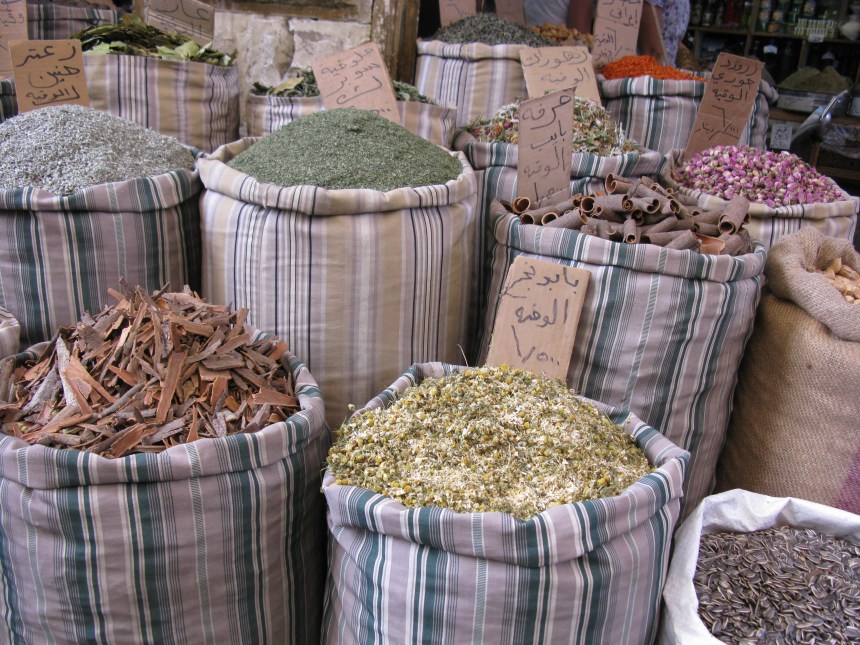
Za’atar is an essential, multi-purpose herb in Middle Eastern cuisine. While it’s translated thyme, it’s typically a mixture of thyme, sesame seeds, and sumac.

(To my scientist friend who was worried about this: yes, sumac is poisonous if you eat a kilo of it, but perfectly safe in small quantities. It gives za’atar a little bite and splashes of that lovely deep red color.)

I half-heartedly apologize to purists while I sprinkle za’atar liberally on my scrambled eggs, roasted chicken (with olive oil), or pita with melted Turkish kashkaval cheese and diced tomatoes.

(I’m tempted to try it on that beautiful snapper, too, which is flown in daily from Yemen, the Carrefour seafood department manager tells me. Sorry, no outdoor fish markets in the desert.)

Honest, I make up for it most mornings by making the classic za’atar paste: just keep adding olive oil until you get what my dad describes as “potting soil” consistency, then spread it on lavash (flatbread) and serve with fresh mint leaves and sliced tomatoes.

With sides of kiwi, mango, grapefruit, and lebne, plain whole milk yoghurt poured through cheesecloth to remove the whey, giving it the consistency of sour cream (and an equally sour taste).

Don’t be me and forget to add a drizzle of olive oil on the lebne before serving!

Around these parts, if you’re the executive chef at your house, your za’atar recipe is a closely guarded family secret. Colonel Sanders isn’t the only one with secret herbs and spices. I’ve received homemade za’atar as a gift and it’s far more interesting than even the best commercial product. Even better than Jordanian za’atar, famous throughout the region.

Everywhere you look, you can buy za’atar for 1,49 JDs (Jordanian Dinars), just under $2, per ½ kilo and you’d be amazed how quickly you can go through that amount.

I’ve heard that some Jordanians believe za’atar improves alertness and concentration. I’m not sure whether za’atar sandwiches will improve my Arabic test scores, but it definitely couldn’t hurt!
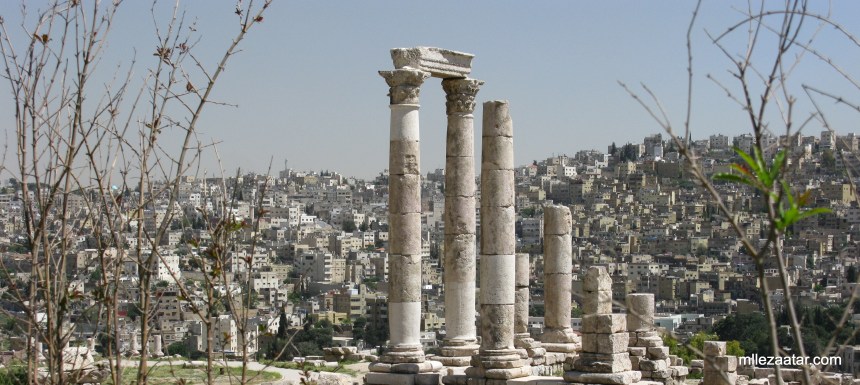
I’ve moved to Philadelphia. Or at least that’s what the Ancient Greeks used to call it.

Today it’s called Amman, Jordan.

Yes, that Jordan: where John the Baptist baptized Jesus of Nazareth, where the Israelites crossed into the Promised Land, where Lot’s wife turned into a pillar of salt.

Where there’s some of the most scenic hiking, biking, and diving in the world, not to mention archeological exploring. If you secretly wanted to be Indiana Jones or Lawrence of Arabia, Jordan is the country for you.

Although border configurations in this part of the Middle East have changed several times in the past several decades, the Land of Milk & Honey (or Canaan) was originally Jordanian territory. Nowadays, the Hashemite Kingdom of Jordan exists east of the Jordan River, in one of the world’s toughest neighborhoods, bordering Israel/West Bank, Iraq, Syria, and Saudi Arabia.

That means I’m stuck out in part of the desert where God’s Chosen People wandered for 40 years.

Believe me, you have to put a LOT of effort into wandering for 40 years in deserts this small, even with a million or two travelers on foot. It’s like saying it took you 40 years to get from Rome to Florence.

Or Seattle to Portland.

So, you have to wonder why the Israelites wanted so badly not to arrive in the Promised Land in a timely fashion that they did pretty much everything possible to avoid it!

Even after 4 decades of meandering and backtracking and stalling, they finally arrived on Mount Nebo, where God had told Moses he could view the Promised Land from afar, but would not be allowed to enter. (Read why in the Old Testament of the Holy Bible, Book of Numbers, Chapter 20.)

I’ll write a post from Mount Nebo later. And from the Dead Sea. And from Petra, the ancient pink city in the south of Jordan, which isn’t lost at all, contrary to what Indiana Jones keeps telling people.

The Middle East is the happening region on the planet right now and the Arab Spring is changing the political, social, and economic landscape of the 21st century.

Jordan, a constitutional monarchy, is calm and it’s no mistake that’s where people in the region run to when there’s trouble.

Consequently, of Jordan’s 6 million or so population, one third are Palestinians, many of whom have Jordanian citizenship. In fact, Jordan’s Queen Rania comes from a Palestinian family.

There are also 500,000 Iraqi refugees in Jordan, whose arrival jacked up all the real estate prices in Amman, as I discovered when I started looking for an apartment.

King Abdullah II recently stated in the press that Jordan is hosting tens of thousands of Syrian refugees, with more arriving with each passing day.

I’m glad that Jordan’s open door policy also includes me. Everywhere I go, Jordanians say, “ahlan wa sahlan.” In Arabic, “ahl” means family, “wa” means and, “sahl” means easy.

Taken together, it means “a very warm welcome,” which I extend to readers worldwide of my new blog from Jordan, !